Pre-Employment Background Check in Southeast Asia

Southeast Asia’s labor market is more connected than ever — and increasingly, so is the risk sitting inside it. According to the Association of Certified Fraud Examiners’ Occupational Fraud 2024 report, Asia-Pacific recorded the highest average loss per fraud case of any region worldwide, at $1.2 million. Much of that risk takes root before an employee is even hired, in the credentials and history employers take at face value during recruitment.
With remote hiring processes becoming a norm, candidates increasingly hold credentials from institutions — financial hubs, manufacturing corridors, shared-services centers — the hiring manager has never heard of.
Southeast Asia forms an important part of this broader APAC landscape. As companies expand across Indonesia, Singapore, Malaysia, Thailand, Vietnam and neighboring markets, employers face additional complexity arising from different legal frameworks, education systems, and verification practices. While the overall hiring risks are reflected in regional data, the way background checks are conducted varies from one Southeast Asian country to another.If you’re hiring in a specific market, you may also find these country-specific guides helpful:
Against this background, an employment verification check is no longer a secondary step in recruitment but a critical safeguard for employers making high-stakes hiring decisions. Relying solely on a candidate’s CV and interview process exposes a company to risks that can be easily overlooked and costly to address later.
What Is a Pre-employment Background Check?
An employment background check is a structured verification process that confirms or disproves the claims a candidate makes about their background. Employers use this process to establish whether:
- A candidate’s identity is genuine
- A candidate’s academic and professional credentials are legitimate
- A candidate’s employment history, including past and current roles, is accurate
Companies rely on verified information to protect operations, satisfy compliance obligations, and avoid costly hiring mistakes. Without proper verification, small information gaps can easily be missed. Over time, those gaps may translate into financial loss, regulatory exposure, or reputational damage.
Why Employment Background Checks Matter in Southeast Asia Today
Hiring risk in Southeast Asia looks different from hiring risk in a single, homogeneous market. A regional employer, or a multinational hiring locally, is dealing with several markets at once – each with its own institutions, regulators, and workculture.
Below are the key trends making background verification especially important in the region right now.
1. Fragmented and fast-growing education systems
Southeast Asia’s higher-education landscape has expanded rapidly, with private colleges, foreign-university branch campuses, and cross-border twinning programmes operating alongside long-established public universities. In many of these arrangements, the institution that delivered the coursework is not the one that issued the degree, and accreditation status is not always obvious on the certificate itself. On paper, a qualification can look entirely legitimate. Without direct verification, employers may have no reliable way to confirm whether a qualification is genuine and issued by the institution authorized to award it.
2. High regional job mobility
Southeast Asia’s workforce, particularly younger professionals, changes jobs frequently, and candidates increasingly move between industries and even between countries within the region over the course of a career. Frequent tenure changes make it harder to assess long-term reliability from CV alone. Employment verification allows employers to confirm whether a candidate’s stated work history is accurate and identify discrepancies that may otherwise go unnoticed.
3. The rise of remote and cross-border hiring
More companies are hiring across borders without ever meeting the candidate in person. This applies to remote roles, regional expansion, or shared-services functions. Remote hiring removes many of the informal verification cues an in-person process provides, which raises the value of formal, documented screening. Remote hiring also means employers must navigate different legal and verification practices across jurisdictions, making standardized screening increasingly difficult.
4. Growing resume fraud and credential misrepresentation
As competition for jobs increases and hiring becomes increasingly digital, organizations are seeing more cases of inaccurate employment histories, falsified academic qualifications, exaggerated skills, and fake professional references. While most candidates are honest, even a small number of misrepresentations can expose employers to financial loss, reputational damage, and regulatory risk. Background screening provides an objective way to verify critical information before a hiring decision is made.
Making Background Screening Work Across Southeast Asia
Hiring across Southeast Asia means hiring across multiple regulatory
environments, education systems, and verification channels at once.
A structured employment background check – run by a provider with
genuine local reach across the region – turns that complexity into a
documented, repeatable process, so hiring decisions are based on verified
facts rather than assumptions.
Making Background Screening Work Across Southeast Asia
Hiring across Southeast Asia means hiring across multiple regulatory environments, education systems, and verification channels at once. A structured employment background check – run by a provider with genuine local reach across the region – turns that complexity into a documented, repeatable process, so hiring decisions are based on verified facts rather than assumptions. Integrity Asia has conducted employment background screening across the region for more than 20 years, with local teams and direct verification relationships in the markets where our clients hire. If your company is evaluating a background screening partner, get in touch for a free consultation to discuss the checks that fit your hiring risk.
Is an Employment Background Check Legal in Southeast Asia?
Yes. Employment background checks are legal across Southeast Asia, provided they comply with each market’s personal data protection framework. While the specific legislation differs from country to country, most regional data protection laws share three core obligations that employers must meet.
Consent
Employers must obtain explicit, documented consent from the candidate before initiating any background check. The consent request should clearly describe which checks will be run and for what purpose, screening should never begin without it.
Purpose Limitation
Data collected during background screening may only be used for the specific purpose for which consent was given. Using that data for any other purpose creates a compliance breach under most regional data protection regimes.
Data Security
Candidate information must be stored and processed securely throughout the screening process. Mishandling personal data, including sharing it with unauthorized parties or failing to protect it from a breach, carries legal and reputational consequences that have grown more severe as data protection enforcement across the region has strengthened in recent years. For candidates with overseas experience, cross-border data transfer rules typically apply as well.
What Does an Employment Background Check in Southeast Asia Cover?
The scope of a check depends on the role, the industry, and the employer’s risk appetite. The elements most commonly verified across the region include:
- Identity verification: Confirms that a candidate’s national identity document or passport is legitimate and matches their application.
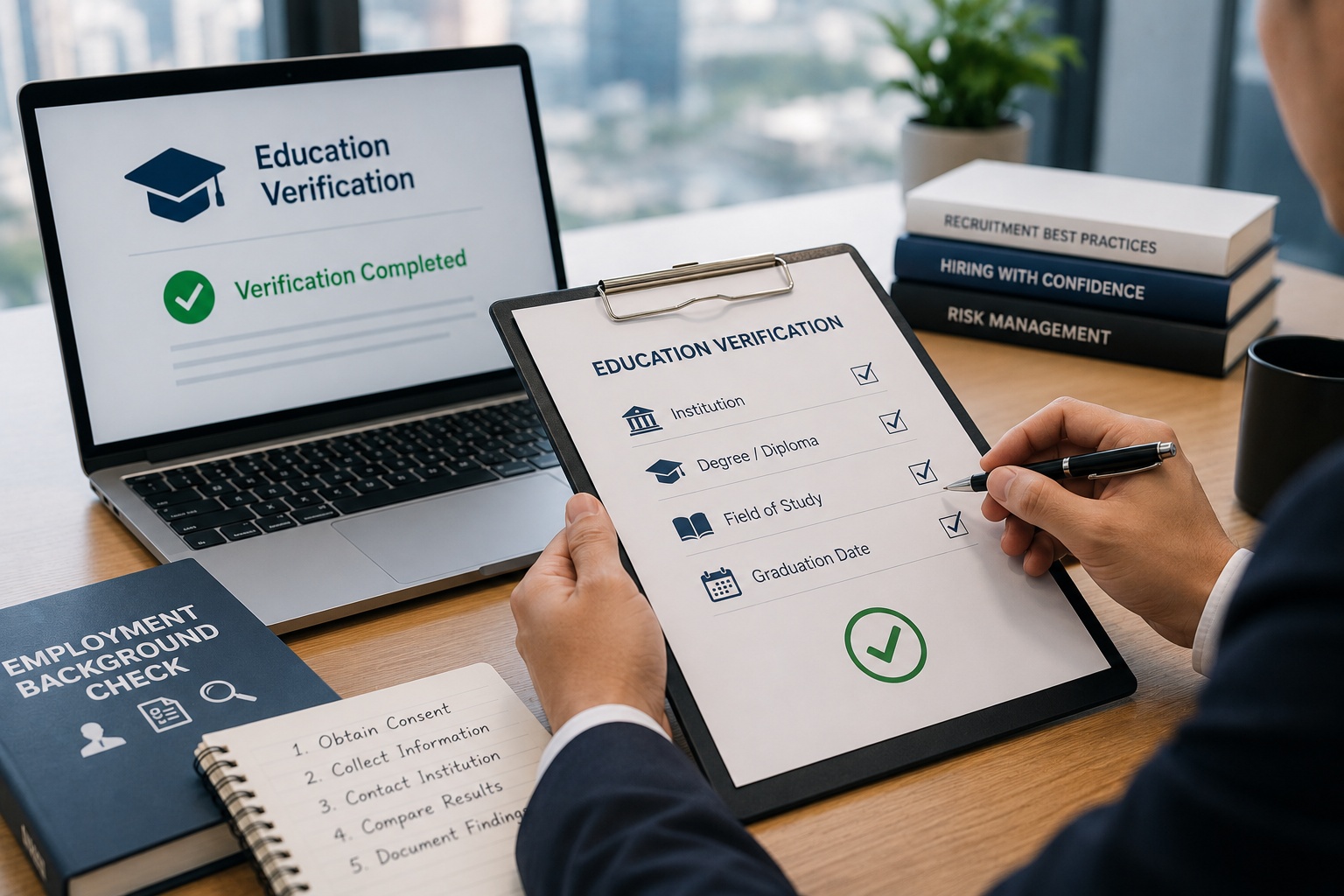
- Education verification: Validates qualifications directly with the awarding institution and checks accreditation status.
- Employment history: Confirms previous job titles, tenure, reporting lines, and where available — reasons for departure.
- Criminal record check: Confirms criminal history through the appropriate government channel or supplementary court and public-record searches.
- Reference checks: Structured conversations with previous managers or colleagues to validate performance and conduct.
- Credit and bankruptcy checks: Reviews a candidate’s credit history and any bankruptcy filings; relevant for roles with financial oversight or access to company funds, and always conducted with consent.
- Professional license verification: Confirms certifications required in regulated fields such as medicine, law, accounting, and financial services.
- Directorship checks: Confirms whether a candidate is registered as a director or shareholder of any company.
- Global sanctions and media checks: Screens candidates against international sanctions lists and publicly available adverse media.
Key Challenges in Background Screening Across Southeast Asia — and How a Specialist Provider Helps
Even employers who genuinely want to run a proper screening process run into practical obstacles when they try to do it in-house across the region.
Navigating multiple regulatory frameworks at once
Complying with data protection law is more than asking for consent. Consent forms must be properly drafted and specify every check being run, data must be stored securely with defined access controls, retention periods must be respected, and cross-border transfer rules must be followed for candidates with overseas work history. For HR teams without dedicated legal or compliance support in every market they hire in, this adds real administrative overhead, and mistakes are not always visible until a complaint or audit surfaces.
How a specialist provider helps:
A qualified screening partner builds compliance into the process by design. Candidates submit consent and personal data through a secure, documented portal built to meet regional data-protection standards, consent language is pre-reviewed for legal sufficiency, and data is retained and deleted according to defined schedules. The employer receives a structured report at the end of the process instead of managing consent trails and data handling in-house.
Verifying education across fragmented systems
With private colleges, foreign campuses, and cross-border programmes all operating under different rules, education checks can be genuinely difficult. Many institutions still verify records manually, which means email exchanges, follow-ups, and waits of several days or weeks for a clear answer.
How a specialist provider helps:
How a specialist provider helps: Specialist providers maintain direct, established relationships with verification contacts at major institutions across the region, so requests are routed to the right person immediately rather than sitting in a generic inbox queue.
Accessing criminal records across jurisdictions
Checking criminal history is rarely as simple as it sounds. Records across Southeast Asia are typically held by national police authorities with no direct query access for employers or most screening firms, and candidate-obtained certificates can take time to process.
How a specialist provider helps:
How a specialist provider helps: Reputable providers supplement official certificates with court record searches, covering civil litigation, bankruptcy filings, and directorship records, that are publicly accessible through official registries. This layered approach gives employers a far more complete picture than a self-declared certificate alone.
Screening across borders and languages
A candidate’s employment or education history may sit in a different country from where they are applying, in a language the employer’s HR team doesn’t speak, verified through an institution or registry the employer has never dealt with before.
How a specialist provider helps:
How a specialist provider helps: A regional provider with local teams and language capability across multiple Southeast Asian markets can verify a candidate’s history at the source, rather than relying solely on documents the candidate submits.
When should you use a third-party background screening provider?
Given the challenges above, the real question is not whether to use professional screening, but which situations make it most valuable.
When the role carries significant risk
Senior hires, roles with access to finances or sensitive data, and positions in regulated industries carry real consequences if the wrong person is appointed. These are the roles where a thorough, multi-layered check — criminal, civil, credit, directorship, sanctions — returns the most value, and where relying on self-disclosed information carries the most risk.
When hiring volume makes in-house management unsustainable
For high-volume hiring, common in manufacturing, retail, and shared-services environments, managing checks case by case is not practical. Third-party providers offer turnaround SLAs, case-tracking dashboards, and bulk processing that make it possible to screen large cohorts consistently without sacrificing quality or compliance.
When you’re expanding into new markets across the region
Every new country brings a new regulator, a new data protection regime, and a new set of local institutions to verify against. A provider that already operates across Southeast Asia removes the need to build that local expertise from scratch each time you enter a new market.
When your team lacks dedicated compliance support
If your HR function does not have a dedicated legal or compliance resource reviewing your screening process, using a provider is the most reliable way to keep the process compliant. The provider’s infrastructure handles consent, data handling, and retention, while your team receives a compliant report.
When evaluating providers, look for:
- Documented, compliant data-handling processes and a secure candidate portal
- Direct verification capabilities with institutions across the region, not just reliance on candidate-submitted documents
- Layered criminal record checking — official certificates plus court, bankruptcy, and civil litigation searches
- Local presence and language capability in the markets you hire in
- Clear, accountable turnaround-time SLAs with case-tracking visibility
- Industry-specific experience relevant to your regulatory environment
A clear policy on data retention and candidate data deletion once screening is complete
Which Industries Require Employment Background Checks in Southeast Asia?
Some industries across the region are required to run employment background checks under sector-specific regulation, while others treat screening as standard practice to manage hiring risk and stay compliant with data protection law.
| Industry | Typical Requirement Level |
|---|---|
| Financial Services & Banking | Mandatory under financial-sector regulatory guidance |
| Healthcare | Mandatory under professional credentialing requirements |
| Education (roles involving minors) | Mandatory criminal background screening |
| Securities & Capital Markets | Mandatory under securities regulator requirements |
| IT & Telecommunications | Standard practice for risk management |
| Manufacturing | Standard practice for risk management |
| Government Agencies | Standard practice |
| Retail & Consumer-Facing Roles | Increasingly common; data protection rules apply |
Frequently Asked Questions: Employment Background Checks in Southeast Asia
Is a background check mandatory for all employees in Southeast Asia?
No. It is not legally required for every role in every market. However, regulation makes it mandatory in specific sectors such as banking, healthcare, education roles involving minors, and securities, and it has become increasingly standard practice across other sectors as well.
How long does an employment background check take?
Basic checks typically take around 3–5 business days. Checks involving overseas history, complex credentials, or multiple jurisdictions can take longer.
How much does an employment background check cost?
Cost depends on the scope of the check, the number of candidates, and which markets the verification needs to cover.
Can a candidate refuse a background check?
Yes. Background checks require the candidate’s explicit consent under regional data protection law, so a candidate may decline to participate. In practice, refusal is rare for roles where screening is a standard part of the hiring process. Employers should communicate clearly from the outset that screening is a condition of the offer, which sets expectations and reduces friction later.
Can a background check verify a candidate’s history in a different Southeast Asian country?
Yes, provided the provider has verification capability in that market. This is one of the main reasons companies hiring across the region use a single regional provider rather than separate local vendors for each country.
What’s the difference between a background check and a reference check?
A reference check is one component of a broader background check. It involves structured conversations with a candidate’s previous managers or colleagues, while a full background check also verifies identity, education, employment history, and other elements independently of what the candidate or their references report.