How to Conduct Education Verification Before Hiring
A resume and an interview tell you a lot about what a candidate wants you to know. What they cannot tell you is whether their degree, diploma or certification is genuine. In the Philippines, the Commission on Higher Education confirmed in February 2026 that it was investigating unaccredited graduate programs – allegedly diploma mills – that misled teachers in Palawan into paying for coursework that would not count toward their promotion. The case was serious enough to reinforce the need for a national registry of legitimate teacher education programs.
Even when employment and identity checks uncover obvious red flags, education credentials present a separate risk: a 2025 EY review of more than one million background checks in India found that fabricated academic claims were consistently among the discrepancies identified. This serves as a useful reminder that education verification is not simply another box to tick, but a distinct layer of screening that can uncover issues other checks may miss.
For HR teams, recruiters, and compliance professionals across Southeast Asia, education verification is a standard part of Pre-employment Background Check before a hire is finalized. It confirms that a candidate’s academic qualifications are accurate, reducing the risk of hiring based on false or exaggerated credentials.
This guide walks through what education verification involves, when to conduct it, what’s required, and how to build a reliable process, including when it makes sense to bring in a professional education credential verification partner.
What Is Education Verification?
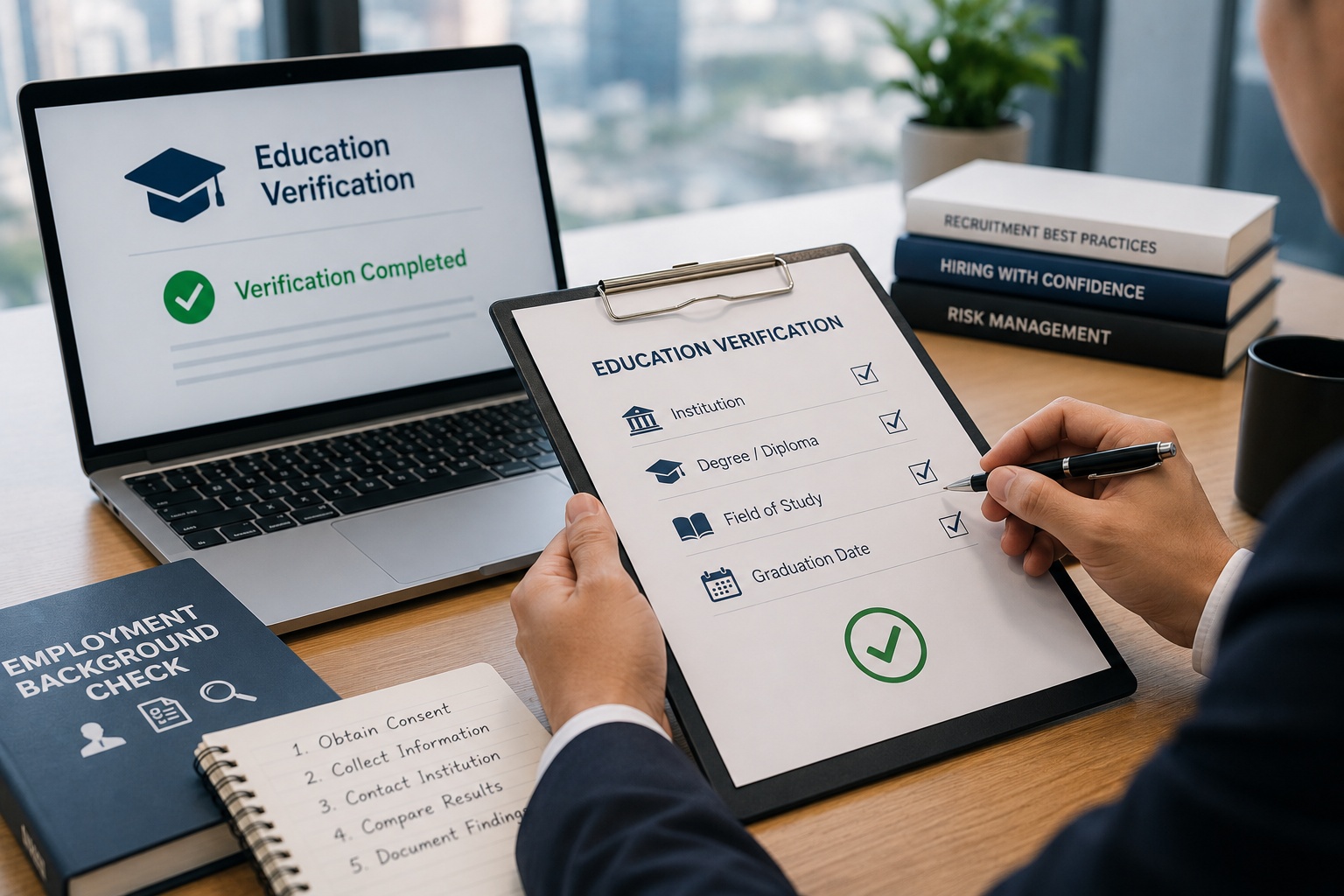
Education verification is a process that confirms whether a candidate’s academic qualifications are genuine and accurately represented. Employers typically verify details such as the educational institution attended, degree or diploma obtained, field of study, and graduation date where applicable.
In recruitment, the terms education credential verification and educational background check are sometimes used interchangeably, but they have slightly different meanings. Education verification focuses specifically on confirming academic qualifications, while an educational background check may refer more broadly to education verification as part of a wider pre-employment screening process.
It is also important not to confuse education verification with credential evaluation, which assesses the equivalency of qualifications from different education systems, or with investigations into fake diplomas, as those topics require separate consideration.
Why Is Education Verification Important?
Reducing Hiring Risks
Educational qualifications often serve as minimum requirements for professional roles. If those qualifications are inaccurate or misrepresented, employers may hire candidates who lack the required knowledge or credentials.
Education verification helps organizations identify discrepancies before employment begins, reducing the likelihood of costly hiring mistakes and improving confidence in recruitment decisions.
Supporting Compliance and Business Integrity
Many organizations include qualification verification within their hiring policies as part of good governance and risk management. In regulated industries or positions requiring specific credentials, verifying educational history demonstrates appropriate due diligence. For example, in the Philippines, accountants, engineers, architects, nurses, doctors, teachers must possess the degree or education prescribed by the relevant professional law (administered by the Professional Regulation Commission/PRC). Meanwhile in Singapore, doctors and medical specialists are required to have the medical degree from a recognised institution or otherwise meet SMC recognition requirements.
Because employment and privacy requirements vary between jurisdictions, employers should ensure their verification practices comply with applicable local laws and obtain candidate consent where required.
Improving Recruitment Quality
Consistent education verification promotes fair and standardized hiring decisions. Rather than relying solely on documents provided by candidates, employers can independently confirm academic achievements, helping ensure that every applicant is assessed using the same verification standards.
When Should Employers Conduct Education Verification?
Education verification is generally most effective after candidates have been shortlisted but before employment is finalized. Many organizations conduct the process after a conditional offer has been made and before onboarding begins.
Verification is particularly valuable for senior leadership positions, regulated professions, and roles involving financial responsibility, compliance, or access to sensitive information. Applying education verification consistently according to internal recruitment policies helps maintain fairness throughout the hiring process.
What Information and Documents Are Required?
Successful education verification depends on accurate information supplied by the candidate.
Typical candidate information includes:
- Full legal name
- Previous names, if applicable
- Date of birth where required
- Student identification number, if available
Academic details commonly include:
- Name of the educational institution
- Degree, diploma, or qualification obtained
- Field of study
- Graduation year
- Campus or faculty where relevant
Supporting documents may include degree certificates, diplomas, academic transcripts, and written candidate consent where legally required. Documentation requirements can differ depending on the institution and jurisdiction, so employers should be prepared for some variation.
How to Conduct Education Verification Step by Step
Step 1: Obtain Candidate Consent
Before beginning any verification activity, employers should obtain the candidate’s authorization where required by applicable privacy or employment laws. Clear communication about the purpose of verification also helps build transparency throughout the hiring process.
Step 2: Collect Academic Information
Gather complete educational details from the candidate and review submitted documents for consistency. Missing or conflicting information should be clarified before verification begins to avoid unnecessary delays.
Step 3: Contact the Educational Institution
Verification may be completed through several methods, including contacting the institution’s registrar, using official verification portals, or working with authorized third-party screening providers. The appropriate method depends on each institution’s verification procedures.
Step 4: Compare Verification Results
Compare the verified information against the candidate’s application. Confirm the institution attended, qualification earned, field of study, and graduation status. Any discrepancies should be investigated before making a final hiring decision.
Step 5: Document the Findings
Record the verification outcome as part of the recruitment file while handling candidate information securely. Proper documentation supports consistency and provides an audit trail for future reference.
Common Challenges in Education Verification
Diploma Mills and Fraudulent Qualifications
One challenge employers may encounter is qualifications issued by diploma mills or unaccredited institutions. These credentials may carry the appearance of legitimacy without representing recognised academic achievement.
While employers should remain alert to potential credential fraud, identifying fake diplomas involves additional considerations beyond the scope of this article.
International Qualifications
Cross-border recruitment can complicate education verification processes. Institutions may operate under different academic systems, maintain records in different languages, or follow different verification procedures.
Organizations hiring across Southeast Asia or internationally may experience varying response times depending on the institution involved.
Incomplete or Unavailable Records
Older qualifications, institutional mergers, or closed educational institutions may make verification more difficult. In these situations, employers may need to use alternative verification channels or seek additional supporting documentation before completing the hiring process.
Best Practices for Education Verification
A consistent verification process improves both recruitment quality and operational efficiency. Employers should establish standardized procedures that define when education verification will be conducted and what information will be verified.
Best practices include obtaining appropriate candidate consent, maintaining secure verification records, applying verification consistently across comparable roles, and using reliable verification sources whenever possible.
Organizations managing large recruitment volumes or hiring internationally should also review whether additional verification expertise is needed to maintain consistency and reduce administrative workload.
When Should Employers Use a Professional Education Check Service?
Professional verification services can be valuable for organizations managing cross-border recruitment or high-volume hiring because they help streamline verification workflows.
As part of Integrity’s Employment Background Check solution, Education Check helps employers verify academic qualifications accurately and efficiently. By supporting verification across Southeast Asia and working with established verification processes, the service can help organizations reduce administrative effort while improving consistency and confidence in recruitment decisions.
Rather than replacing internal hiring policies, professional screening services complement existing recruitment processes by providing specialized verification expertise when it is needed most.
Frequently Asked Questions
How long does education verification usually take?
Education checks are typically completed within 5–7 business days. However, processing times may vary depending on the country, educational institution, and availability of records.
Can employers verify qualifications from overseas universities?
Yes. However, international verification may involve different procedures, documentation requirements, and response times depending on the institution and jurisdiction.
What happens if an educational qualification cannot be verified?
Employers should investigate the reason, request additional documentation where appropriate, and assess whether the inability to verify the qualification affects the hiring decision.
Do employers need candidate consent before conducting education verification?
Yes. Requirements differ across jurisdictions. Employers should follow applicable privacy and employment laws and obtain candidate consent where required.