Employment Background Check in Vietnam: A Practical Guide

An employment background check in Vietnam is increasingly important as the country’s labor force grows. According to the National Statistics Office, Vietnam’s labor force reached about 53.6 million people in the first quarter of 2026. The manufacturing, technology, and services sectors keep expanding. A bigger talent pool raises a simple question: how can you be sure that candidates have the qualifications and experience they claim? A polished CV and when hiring moves fast, discrepancies slip through, later becoming operational, financial, or reputational problems.
Why Employment Background Check Matters in Vietnam’s Hiring Market
Frequent job changes mean a candidate’s history often spans several employers, and sometimes several countries. Records are not centralized. Claims on a CV do not always match reality. In a competitive market, guessing is an expensive way to hire.
The logic is straightforward:
- Unverified information leads to uncertain hiring decisions.
- Uncertain hiring decisions create real business risk.
- Screening replaces assumptions with documented evidence you can show to leadership, auditors, or regulators.
Skipping verification can lead to hiring errors, compliance failures, disruption to operations, and reputational harm. These costs usually exceed the cost of a screening package.
What an Employment Background Check Really Means in Vietnam
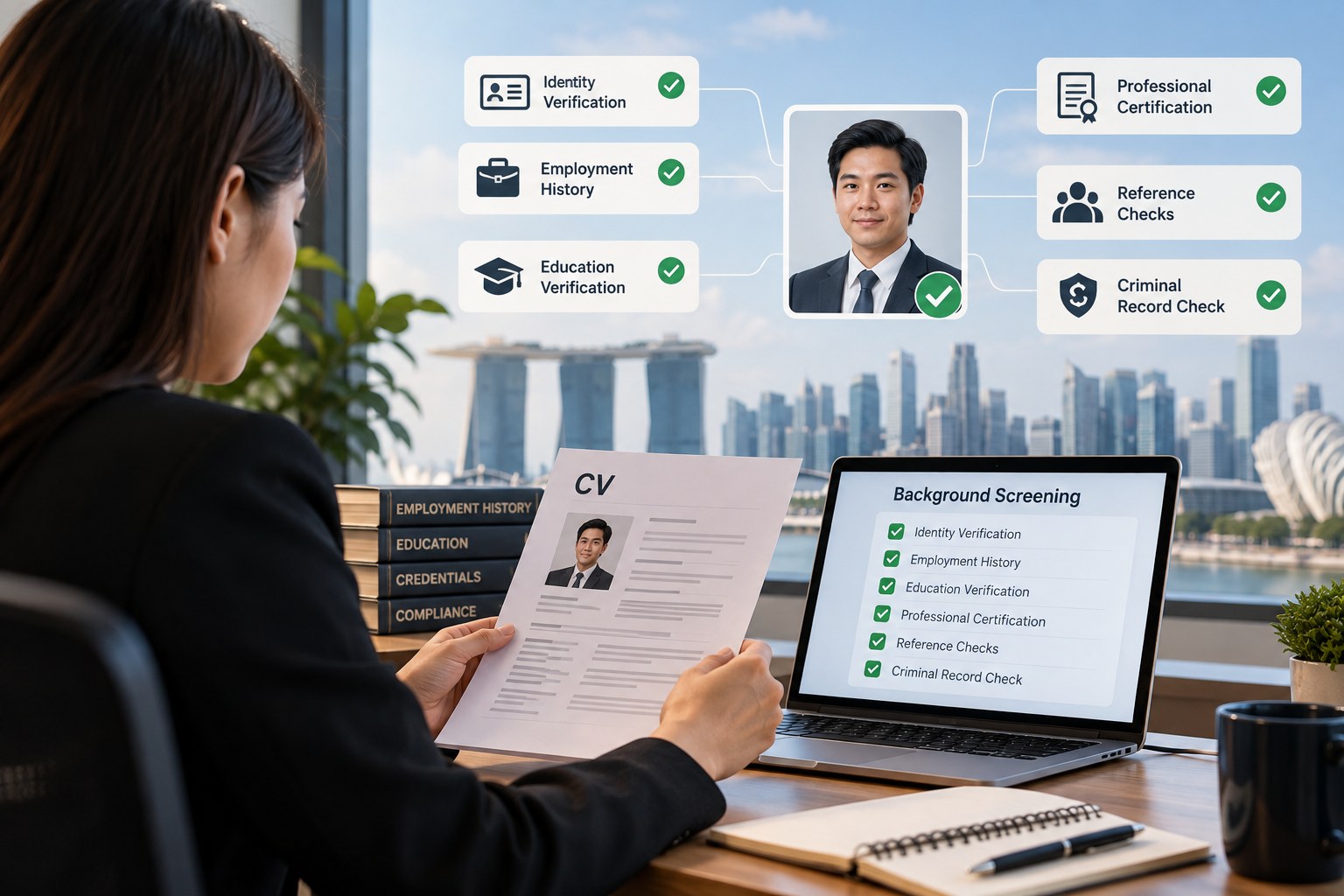
An employment background check in Vietnam isn’t a single action. It’s a system of checks, each one answering a key hiring question:
- Is this candidate who they say they are? (identity verification)
- Did the candidate attend the institution they claim? (education verification)
- Did they actually work in those roles? (employment verification)
- Can they be trusted in sensitive positions? (criminal records where lawful)
- What do credible referees say about their work behavior? (references)
- Does the candidate have a financial history that could indicate potential risks in positions involving financial responsibility? (credit check)
Each step fills a gap that interviews can’t. Together, they help employers build a hiring decision they can defend with confidence.
If you are wondering whether all of these checks are necessary, the answer ultimately depends on the level of risk your organization is willing to bear.
Common Types of Background Checks Used in Vietnam
Employers in Vietnam deploy different types of background checks depending on the position, industry, and level of responsibility involved. Understanding the types of background checks commonly used in Vietnam can help organizations determine which screening methods are most relevant to their hiring needs.
| Check | What it confirms | Typical source | Most used for |
|---|---|---|---|
| Identity and right-to-work | Legal identity and eligibility to work in Vietnam | National ID card, passport, or temporary residence card (TRC) for foreigners | Every hire |
| Education and qualifications | Degrees, diplomas, certifications and completion dates | Issuing university or institution; education authorities such as Ministry of Education and Training (MOET) where relevant | Professional and technical roles |
| Employment history | Job titles, employment periods, responsibilities and reason for leaving | Former employer HR departments or supervisors | Every hire |
| Criminal record | Convictions and legal or trust-related risk | Judicial Record Certificate issued by the police authority, via VNeID or the National Public Service Portal | Sensitive roles, finance, work permits |
| Reference check | Performance, conduct and working style | Former managers and colleagues | Managers and senior hires |
| Credit check | Financial responsibility and risk exposure | Credit Information Center (CIC) records, with consent | Banking, finance, accounting |
Additional Screening Types Employers Also Consider
Many organizations now use additional screening measures based on role sensitivity, industry standards, or internal policy.
Social Media Screening
Some employers review publicly available information to understand professional conduct and reputational risk. This must be done proportionately and with respect for lawful boundaries.
Credit Checks
More common in banking, finance, and senior financial roles, these checks help assess financial responsibility and risk exposure.
Residential / Address Verification
Useful for roles requiring trust, access, or security clearance to ensure identity consistency.
Drug Testing (Industry Specific)
Some sectors such as logistics, manufacturing, healthcare, or safety-critical environments may use fitness-for-duty screening as part of risk control.
Not sure which checks your roles need?
Integrity Asia can scope a screening package by role level, industry, and country.
Digital Verification Trends in Vietnam: The Growing Role of VNeID
Vietnam is modernizing identity management, and VNeID is a major step. Think of it as a trusted digital identity backbone that can reduce dependence on paper documents in the future.
What this signals for employers:
- identity checks may become faster
- validation may become stronger
- HR processes may eventually integrate digitally
Most companies still rely on institutional checks today. Meanwhile, organizations closely monitoring VNeID developments are better prepared for future changes.
Employment Background Screening for Foreign Hires and Work Permits
Screening is closely tied to the work permit process for foreign employees. Decree 219/2025/ND-CP, effective August 7, 2025, lets employers submit the work permit application and the criminal record certificate request together through the National Public Service Portal.
Employers typically prepare the following. Requirements vary by role type, so confirm them against current regulations.
- Identity and legal status: a valid passport and immigration or residence records.
- Qualifications: verified degrees or certificates, plus confirmation of work experience from previous employers. Experts generally need a relevant university degree and at least two years of experience.
- Criminal record: a certificate issued within six months before the application is submitted.
- Employment documents: an employment contract or offer, and employer documentation.
- Health: a medical certificate, valid for up to 12 months.
Foreign documents often need consular legalization and certified translation. Unverified or inaccurate records can delay or sink an application, so many employers validate documents before submitting.
Legal and Regulatory Considerations Employers Must Understand
Background screening is permissible in Vietnam when conducted lawfully and proportionately. Employers must ensure that screening respects candidate rights while serving legitimate employment purposes.
Candidate Consent
Informed, written consent is essential before any personal data is verified. Candidates must understand:
- what information will be checked
- why it is being checked
- how it will be used
Consent reinforces transparency and fairness.
Labor Code Considerations
Vietnamese labor law (Law No. 45/2019/QH14) allows reasonable reference checks and verification of candidate information as part of the hiring process, provided employee rights are not violated.
Personal Data Protection Law (PDP Law 91/2025/QH15)
PDP Law 91/2025/QH15 was passed on June 26, 2025, and takes effect from January 1, 2026, replacing Decree 13/2023/ND-CP with comprehensive rules on data handling. The newly enacted law creates Vietnam’s first comprehensive personal data protection framework. Key areas include:
- stronger rights for data subjects
- stricter consent and notification requirements
- clearer obligations for organizations processing personal data
Employers must ensure screening practices comply with these evolving requirements.
Data Handling, Storage, and Third-Party Use
Employers should clearly define:
- What personal data is being collected
- How long it will be stored
- Whether it will be shared with third parties
Clear documentation helps demonstrate compliance and supports accountability.
Cross-Border Data Transfer
Organizations using overseas screening support or global HR systems must ensure any transfer of personal data outside Vietnam complies with applicable legal standards and respects candidate rights.
Screening for Different Hiring Situations
Screening expectations vary depending on the hiring context.
- High-risk or sensitive roles may require deeper verification
- Regulated sectors such as finance, healthcare, logistics, education, and technology often have stronger due-diligence expectations
- Foreign nationals or expatriate hires may require verification of overseas education, employment, and, in some cases, foreign criminal record documentation
- Remote roles still require strong identity and history verification to ensure reliability
Proportional screening ensures fairness while managing risk appropriately.
Best Practices for Responsible and Effective Background Checks
Effective background check is structured, transparent, and proportionate. Employers can strengthen outcomes by:
- clearly informing candidates about screening scope and purpose
- obtaining written consent before screening
- aligning checks with role relevance and actual risk
- using reliable sources and local expertise
- documenting processes, outcomes, and consent
These principles support compliance, fairness, and trust.
Operational Challenges Employers Commonly Face
Employers should also anticipate practical realities:
- employment records dispersed across multiple organizations
- limited availability of older documentation
- varying processing times for criminal certificates
- challenges verifying foreign records
- evolving data privacy requirements
Understanding these challenges helps organizations design screening procedures that are realistic, compliant, and efficient.
Should Employers Use Third-Party Screening Providers?
Many organizations choose to work with professional background screening providers to improve efficiency, ensure consistency, and reduce compliance risk. Local expertise is often important for navigating documentation formats, language requirements, and administrative processes in Vietnam.
However, accountability ultimately rests with the employer, and screening must always be conducted lawfully, ethically, and transparently.
FAQ
Is background screening mandatory in Vietnam?
Background screening is not legally required for every position in Vietnam. However, specific checks may apply to certain roles in highly regulated industries, such as banking and finance, healthcare, education, and aviation. In addition, employers conduct background screening to verify candidate information, reduce hiring risks, and support compliance efforts.
Is candidate consent required?
Yes. Written consent is required before collecting or verifying personal data.
What is the turnaround time for employment background screening?
Basic checks may take 3-5 working days; criminal record and international verification may take several weeks.
Can foreign companies conduct screening in Vietnam?
Yes, provided they comply with local legal requirements and obtain proper consent.
What are the risks of skipping verification?
Higher exposure to hiring errors, compliance failures, operational disruption, and reputational harm.